
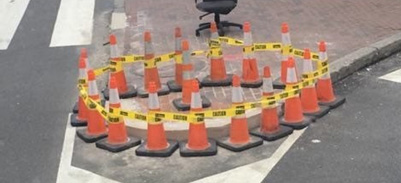
New York photographer Alison Colby is captivated by the ubiquitous objects, and has exhibited studies of them in their natural habitat.
Andy Warhol had his soup cans, Rubens had his voluptuous nudes and Picasso, his ladies with many noses. For Alison Colby, it is traffic cones.
For nine years, Colby has been capturing traffic cones in the wild – which is to say, on pavements and at the side of the street in New York City. She photographed them ineffectually guarding squares of wet concrete or holes in the road. She photographed them swathed in yellow caution tape or mustered for no apparent reason beside lamp posts and fire hydrants.
“I just started seeing them all the time,” she said. She liked the way they looked. “Orange is not my favourite colour but I like the way they slice and dice the landscape. They say: ‘This is a space. Watch out. Be careful. And oh, by the way, we’re not that serious’.”
Colby, 64, who works for a publishing company, took 1,600 photographs of traffic cones, posting them on Insta gram. An artist who saw them got in touch and urged her to exhibit them, with the proper fanfare, at an art gallery.
“He told me: ‘This is a body of work’,” she said.
So it was that at the Wallkill River Center for the Arts, in the Hudson Valley, a crowd gathered for wine and New York themed hors d’oeuvres while gazing at photographs of traffic cones. Patrons of the arts attended as well as the head of the county arts commission, Colby said. There was no one from the local high ways department, however, although she learnt that a member of staff at the gallery had shared the images with their father, who works in construction. “Apparently their father was really excited,” she said.
The traffic cone first burst into the world in 1940s California. “At present it is customary to use small wooden tripods … to indicate the presence of dangerous spots in the highway,” wrote Charles Scanlon, father of the traffic cone, in a patent application in 1941.
The wooden ones were hard to spot and awkward to deploy. “It is therefore a major object of my invention to pro vide a marker that is readily visible,” he wrote. It would be easy to stack and transport, it would not damage cars that ran into it and it “would return to its upright position after a glancing blow”.
In the decades that followed, the orange cones conquered the world, or at least the portions of it that needed to be marked off as hazardous to traffic. “I’ve seen them in Bali, I’ve seen them in Spain,” said Colby. “Now that I’ve had this show, people send me images of traffic cones from all different kinds of places.”
One was of a giant traffic cone built this year at the Burning Man festival in Nevada. The American artist, Dennis Oppenheim, had done something similar in 2007, producing a series of fibreglass traffic cones 4.5 metres high.
Another incursion by a traffic cone into the art world has been witnessed in Glasgow, where an orange cone has rested for decades on an equestrian statue of the Duke of Wellington, like a pointy orange hat. Efforts by the city council to stop locals putting a traffic cone on the duke’s head, by raising the height of the statue’s plinth, provoked a petition in 2013 that attracted 10,000 signatures.
“The cone on Wellington’s head is an iconic part of Glasgow heritage,” the petitioners declared. The plan was shelved. The artist Banksy called it his favourite work of art in Britain.
But no artist before Colby had offered so complete a set of portraits of the traffic cone in its natural habitat. Some cones in her photographs look faintly heroic; others hapless. Some have been mutilated, some have lost their tops. Her favourite photograph of the entire series shows three stacks of green cones lined up like soldiers around the base of a lamp post, which casts a curving shadow across the road beyond them. In front of them, the torso of an orange traffic cone, with no base, lies flat on its side.
“There’s something about the shadow that reminds me of the War of the Worlds,” said Colby. “The green cones look really menacing to me and what happened to that orange? It’s like a murder scene.”
By Will Pavia, new York
Leave a Reply